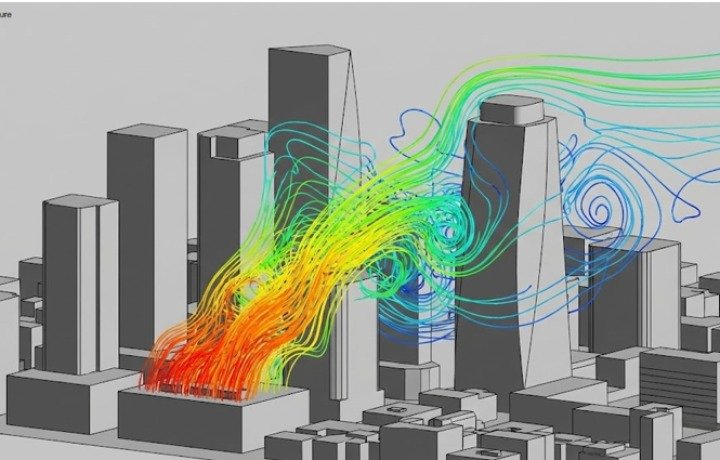
Modern infrastructure projects require advanced engineering solutions to address fire hazards, smoke movement, indoor air quality, and emergency ventilation requirements. Computational Fluid Dynamics (CFD) modelling enables engineers to simulate complex airflow conditions and evaluate system performance under normal and emergency scenarios. From underground parking facilities to transportation tunnels and high-rise buildings, CFD analysis supports informed design decisions, risk assessment, and compliance with applicable engineering standards. lavaconsultants delivers specialised modelling approaches that help project stakeholders understand ventilation challenges and develop effective fire safety strategies.
Enhancing Tunnel Ventilation with Tunnel CFD
Tunnel ventilation systems must maintain appropriate airflow conditions and support smoke management during fire emergencies. Tunnel CFD enables engineers to analyse smoke propagation, temperature distribution, critical velocity, and the performance of mechanical ventilation systems.
By investigating different fire locations, heat release rates, and ventilation configurations, engineers can identify potential smoke accumulation zones and assess the effectiveness of emergency extraction strategies. These simulations provide detailed insights into airflow interactions and help optimise tunnel ventilation designs.
Accurate modelling also supports the evaluation of emergency operating procedures and provides valuable information for infrastructure safety planning.
Advanced Evacuation Assessment Using Egress CFD
Safe evacuation is a central objective of fire safety engineering. Egress CFD helps evaluate environmental conditions along escape routes by analysing smoke concentration, visibility, temperature, and airflow behaviour during fire incidents.
Engineers can use simulation results to identify areas where hazardous conditions may develop and evaluate the effectiveness of proposed evacuation arrangements. Assessments can include different fire scenarios, ventilation failures, and changes in building configuration.
Integrating evacuation analysis with fire and smoke simulations helps improve the understanding of occupant exposure and supports performance-based fire safety assessments.
Comprehensive Tunnel Fire safety and Fire CFD
Effective Tunnel Fire safety requires reliable analysis of fire growth, heat transfer, smoke movement, and emergency ventilation performance. Advanced modelling helps engineers understand how different fire scenarios influence tunnel conditions and the effectiveness of protective systems.
Fire CFD simulations provide information about temperature fields, heat release behaviour, combustion processes, and interactions between fire and ventilation airflow. These findings help engineers evaluate potential thermal hazards and compare alternative safety strategies.
A systematic assessment considers realistic design scenarios, appropriate boundary conditions, and relevant regulatory requirements to produce meaningful engineering results.
Improving Smoke Management Through Smoke CFD
Smoke can rapidly affect visibility, occupant safety, and emergency response in enclosed environments. Smoke CFD provides a detailed assessment of smoke transport, stratification, temperature variations, and extraction performance.
Engineers can analyse how smoke travels through corridors, basements, large enclosures, and connected spaces. Simulations also help evaluate the influence of ceiling height, ventilation openings, extraction points, and mechanical airflow on smoke distribution.
These insights support the development of effective smoke management strategies and help identify potential weaknesses before systems are installed.
Reliable Car park fire modelling for Underground Facilities
Underground parking structures present complex fire safety challenges because smoke and heat can spread across large areas. Car park fire modelling enables engineers to examine fire development, temperature distribution, smoke movement, and ventilation effectiveness under representative emergency conditions.
Detailed car park smoke modelling helps assess smoke layer development, visibility conditions, and extraction system performance. Meanwhile, car park cfd simulations provide information about airflow distribution, recirculation, and the interaction between ventilation equipment and the parking structure.
These assessments help engineers evaluate alternative layouts and develop ventilation strategies aligned with project-specific fire safety objectives.
Optimising Ventilation with jet fan car park CFD
Jet fan systems are commonly used in enclosed parking facilities to direct airflow and support contaminant removal. jet fan car park CFD evaluates fan placement, airflow momentum, ventilation effectiveness, and potential stagnant zones.
Engineers can compare different fan arrangements and investigate their performance under normal ventilation and emergency smoke control conditions. Simulation results help determine whether the proposed system achieves the intended airflow distribution and supports the required operational objectives.
A well-developed modelling strategy can also help reduce design uncertainties and identify opportunities for ventilation system optimisation.
Air Quality Management Through car park CO modelling and CO modelling uae
Maintaining acceptable air quality is essential in enclosed parking environments. car park CO modelling evaluates carbon monoxide distribution under different vehicle emissions, traffic conditions, occupancy assumptions, and ventilation rates.
For projects in the United Arab Emirates, CO modelling uae supports the assessment of parking ventilation strategies against applicable local regulations and project-specific air quality criteria.
These studies help identify areas where contaminant concentrations may increase and allow engineers to evaluate ventilation controls, extraction locations, and monitoring arrangements. Reliable results depend on appropriate emission assumptions and realistic operating scenarios.
Protecting Escape Routes with Stair Pressurisation Modelling
Staircases provide essential protected routes during building emergencies. stair pressurisation modelling assesses pressure differences between stairwells and adjacent spaces to evaluate the potential for smoke infiltration.
Using stair pressurisation cfd, engineers can investigate airflow patterns, leakage paths, door-opening effects, and pressure variations across multiple floors. This analysis supports the assessment of pressurisation system performance under different operating conditions.
Furthermore, stair pressurisation network modelling examines interconnected airflow paths through stairwells, shafts, doors, and leakage openings. Combining network calculations with CFD analysis provides a more comprehensive understanding of pressure distribution and fan requirements.
Conclusion
CFD modelling provides valuable technical insights into fire behaviour, smoke movement, ventilation effectiveness, and contaminant distribution. By evaluating realistic scenarios, engineers can identify potential hazards, improve design decisions, and support compliance with relevant fire safety requirements.
lavaconsultants offers a structured approach to specialised engineering assessments across tunnels, parking facilities, and protected escape routes. Integrating advanced simulation techniques into the design process supports effective ventilation planning, informed risk evaluation, and safer building and infrastructure environments.
Congrats! You’ve Finished This Blog.