Modern automation systems need to move products quickly without compromising their quality. This challenge becomes especially important when robots handle fragile, irregular, soft, or easily bruised items. Traditional rigid grippers can apply concentrated pressure, create sudden impacts, or fail to adapt to changing product shapes. These issues can lead to scratches, cracks, bruises, deformation, and product loss.
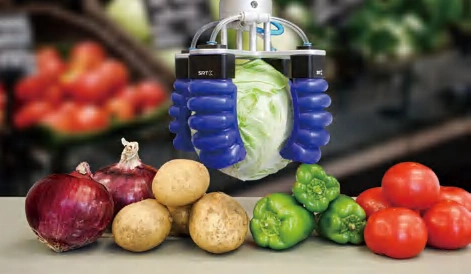
A Soft robotic gripper offers a different approach. Instead of relying only on rigid mechanical fingers, it uses compliant materials and adaptive movement to surround and hold products more gently. This flexibility allows the gripper to adjust to different shapes while maintaining a secure grip. Research into soft robotic grippers highlights compliance and adaptability as important advantages when handling delicate objects.
How Does Soft Gripping Protect Fragile Products?
Soft gripping reduces product damage by creating more compliant contact between the gripper and the product. A rigid finger may touch an object at a small contact point and concentrate force in one area. A soft finger can deform around the object and distribute contact over a larger surface.
This difference matters when robots handle products such as baked goods, fruits, vegetables, meat, packaged foods, and other delicate items. Instead of squeezing one location aggressively, the gripper can conform to the product and maintain a stable hold.
Soft materials also help absorb some of the mechanical interaction that occurs during picking and placement. This can reduce sudden shocks compared with direct contact from rigid surfaces. Researchers have long identified compliance as an important factor in preventing damaging impacts during robotic grasping.
Why Does Product Conformity Matter During Robotic Picking?
Products rarely have perfectly identical shapes. Even items from the same production batch can vary in size, weight, texture, and orientation. A fixed rigid gripper may require precise positioning to achieve a reliable grasp.
A Soft robotic gripper can accommodate these differences through deformation. Its fingers can change shape as they contact the product. This allows the gripper to create a more natural and adaptable grasp without requiring extremely precise positioning for every item.
Recent research into food-industry applications demonstrates this principle by designing soft grippers around different grasp strategies and product characteristics. The study found that optimized soft fingers could achieve high trajectory accuracy across diverse food-handling tasks.
This adaptability can reduce failed picks. When products do not slip or fall from the gripper, manufacturers can reduce the risk of impact-related damage during automated handling.
How Can Soft Gripping Distribute Force More Evenly?
Force distribution plays a major role in protecting delicate products. Applying excessive force to a small area can create pressure that damages a product even when the robot successfully picks it up.
Soft fingers naturally deform when they encounter an object. This deformation can increase the contact area and distribute the gripping force across more of the product’s surface. The result is a secure grasp that does not depend entirely on high squeezing pressure.
For example, when handling a soft food product, the goal is not simply to hold it tightly. The gripper needs to maintain enough force to prevent slipping while avoiding unnecessary compression.
Research on compliant grippers for agricultural produce similarly focuses on soft contact surfaces, grasp stability, and friction to support damage-free handling.
Can Soft Robotic Grippers Prevent Slipping and Dropping?
Yes, proper Soft gripping can help maintain stable contact with products. A weak grasp can cause an item to slip from the gripper during acceleration, movement, or placement. Once a product falls, it may collide with equipment, another product, or a conveyor.
A secure soft grasp can reduce this risk by allowing the gripper to envelop or conform around an object. This approach creates multiple contact points and helps maintain stability while the robot moves.
Soft Robotics Inc describes its robotic gripping technology as using an enveloping grasp to hold products securely during high-speed picking. Its published materials also connect reliable gripping with reduced product damage during automated operations.
This capability becomes particularly useful on fast production lines. A robot does not need to choose between speed and careful handling when the end-of-arm tooling can maintain a reliable grasp.
How Does Adaptive Gripping Handle Different Product Shapes?
A major advantage of a Soft robotic gripper is its ability to handle product variation. Rigid tooling often works best when products have consistent dimensions. However, manufacturers frequently process products with different shapes, sizes, textures, and weights.
Soft grippers can adapt their fingers to these variations. The material itself contributes to the gripping process, which can reduce the need for complex individual finger movements.
This adaptability can make automation more practical for high-mix production environments. Instead of using a completely different gripping mechanism for every product, manufacturers can use an adaptable system designed for a wider range of applications.
Soft Robotics Inc, for example, highlights applications where soft grasping handles products with different sizes, shapes, weights, and forms.
How Can Soft Gripping Reduce Damage During High-Speed Automation?
Speed increases the consequences of an unreliable grasp. When a robot moves quickly, a poorly secured product can slip, swing, collide with nearby equipment, or fall before reaching its destination.
A Soft robotic gripper can help address this challenge by combining compliance with a stable grasp. Instead of gripping an item at one rigid point, its fingers can adapt around the product. This can provide better contact while reducing unnecessary pressure.
Soft Robotics reports that reliable gripping helps support high-speed robotic picking while reducing the likelihood of products slipping or being damaged during movement.
Recent research also shows continued development of soft grippers specifically for high-speed handling of fragile food products. One 2026 study found that compliant contact and avoiding excessive compression were important factors in stable handling at extreme speeds.
What Products Can Benefit From Soft Robotic Grippers?
Many industries can benefit from gentle automated handling. Food processing and packaging are particularly relevant because products can have irregular shapes and fragile surfaces.
Examples include:
- Fresh fruits and vegetables
- Bakery products
- Meat and poultry
- Snacks and packaged foods
- Eggs and other delicate foods
- Irregularly shaped consumer products
- Soft or deformable manufactured items
In these applications, damage can reduce product value, increase waste, and create additional handling costs. A suitable Soft robotic gripper can help maintain product quality while supporting automated production.
The technology is not limited to food. Soft robotic grippers are also being researched for applications involving deformable and fragile objects because their compliance allows them to adapt to objects that rigid grippers may handle poorly.
How Does Better Gripping Improve Production Efficiency?
Reducing product damage does more than protect individual items. It can also improve overall production efficiency.
When a robotic system drops fewer products or damages fewer items, operators can reduce waste and minimize interruptions. A reliable gripper can also help maintain consistent picking performance throughout a production shift.
Better gripping can support faster operation because manufacturers do not necessarily need to slow the robot to compensate for an unstable end-of-arm tool. The combination of vision, intelligent control, and Soft gripping can help robots identify, pick, and place products more consistently.
For example, Soft Robotics’ mGripAI system combines 3D vision, artificial intelligence, and soft grasping for automated picking applications. The company states that its intelligent soft grasping algorithms are designed to limit pile disruption while maintaining a firm but delicate grasp.
What Should Manufacturers Consider Before Choosing a Soft Robotic Gripper?
Not every product requires the same gripper design. Manufacturers should evaluate product weight, size, texture, surface characteristics, fragility, production speed, and required picking accuracy.
They should also consider the gripper’s material, cleaning requirements, gripping force, payload, operating environment, and compatibility with existing robotic equipment.
Testing remains important. A gripper should demonstrate that it can hold products securely without excessive compression or unwanted deformation. Manufacturers should evaluate both successful picks and failure cases before implementing the technology across a production line.
Why Is Soft Gripping Becoming Important for Modern Automation?
Automation continues to move beyond simple, repetitive handling toward applications involving variable and delicate products. This shift creates a need for robotic tools that can combine speed, flexibility, accuracy, and gentle handling.
A Soft robotic gripper addresses this need by using compliant materials and adaptive grasping to interact with products more naturally. Its ability to conform to different shapes, distribute contact forces, and maintain stable handling can help reduce damage during automated picking and placement.
For manufacturers, the goal is not simply to automate product movement. The goal is to automate it while preserving product quality. By selecting the right gripper design and matching it to the application, companies can create automated systems that handle products more carefully while maintaining efficient production.
Congrats! You’ve Finished This Blog.